

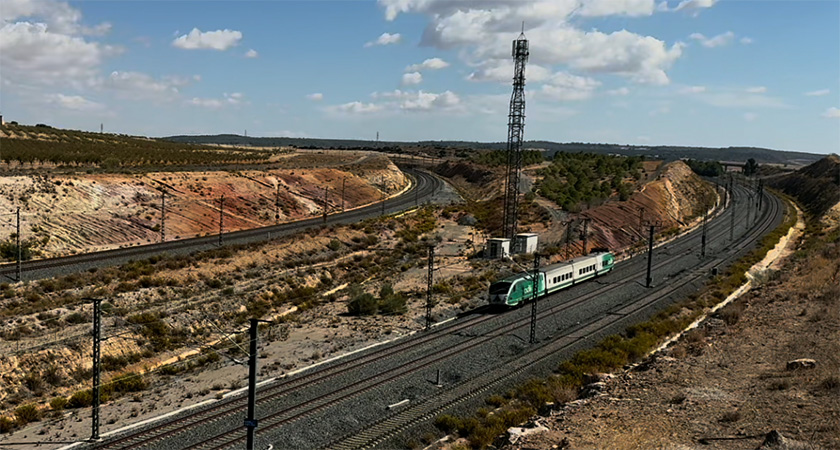
Some stories begin in silence. At night. On an empty platform in Durango, while a train runs along a track that will not receive its first passengers for several hours. There, a few months ago, the MoySEST project wrote its first real chapter: the confirmation that a private 5G network and MCX technology could support the critical communications of a train in full operation. It was an important milestone, but not the end.
With all the work completed and the experience gained during the project’s trials, the Teltronic team prepared for a greater challenge: validating an end to end FRMCS solution, entirely their own, in a real high speed environment.
The leap to Bonete
The chosen scenario was a 37 kilometre section of the Madrid–Alicante line. There, Teltronic deployed a private 5G network specifically designed to support the traffic, requirements and stability demanded by the FRMCS standard.
In parallel, a train equipped with state of the art onboard technology became the main protagonist. From its cab, at speeds of up to 200 kilometres per hour, it transmitted voice, data and video communications. It was not a theoretical exercise: the system sent streams that included continuous geolocation and simulated railway signalling data, exactly as if the train were performing a commercial service.
At Bonete’s technical centre, the heart of the deployment was beating: the 5G core, the MCX server and the control room. Engineers monitored the journey in real time, paying attention to every call, every video stream, every position update… The objective was to determine whether this solution, designed and deployed entirely by Teltronic, could maintain the quality, safety and stability required in the railway environment.
The answer
The train covered more than 900 kilometres during the validation days. And kilometre after kilometre, the technology performed as expected. The transmission rates necessary to support all the planned FRMCS services were achieved: mission critical voice, accurate geolocation, exchange of information for railway signalling and real time video transmission.
Calls were made from the onboard radio, from mobile terminals with MCX applications and from the dispatch centre. An international interoperability scenario was even simulated, testing roaming between 5G systems to demonstrate that MCX communications remained operational in transit.
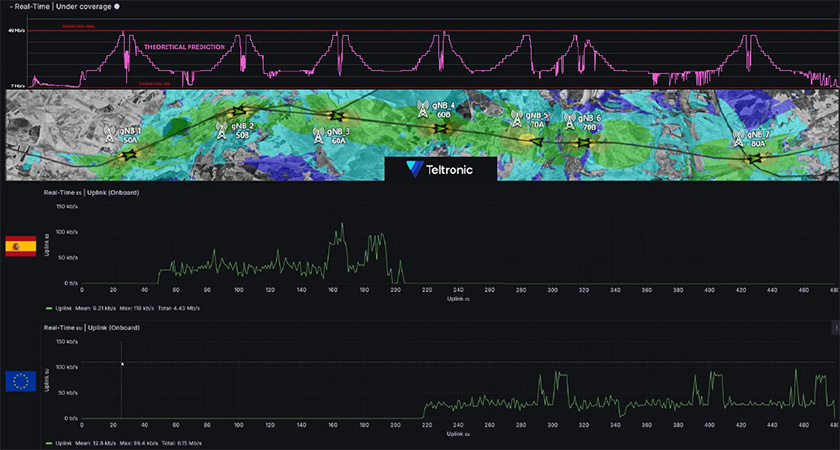
Another cornerstone of the future railway—cybersecurity—was also put to the test, and every induced anomaly was detected, recorded and neutralised.
A validation with its own identity
In Bonete, Teltronic has taken railway communications to a truly pioneering milestone: the first ever validation of the full operation of a complete FRMCS solution in a high speed environment—implemented with a system designed and deployed from start to finish by the company.
A proprietary, replicable and interoperable model, ready to transform railway operations. A solution that not only meets the standard: it helps drive its evolution.
Teltronic thus positions itself as a benchmark in innovation and as a leader in the deployment of FRMCS. The experience in Bonete confirms that the future of train to ground communications, based on 5G and MCX, is already a present reality—one that now runs at 200 kilometres per hour.